Showing posts with label Character Motivation. Show all posts

Tuesday, April 28, 2015

Han Knows Women

I came across this meme the other day, causing a discussion with my wife. Like many people, she feels Han played the rogue when he failed to tell Leia he loved her in return.

I think it played out differently.

A Little History First
Cast your mind back. Our intrepid heroes are held prisoner by Darth Vader in Lando Calrissian's, Cloud City. They've been torchured and generally mistreated in an effort to lure Luke Skywalker there. Looking for a safe way to transport his dangerous cargo back to his master, Vader comes up with the idea to freeze him in carbonite. Calrissian warns Vader that putting humans in carbonite could potentially kill them. Vader decides to test the carbon freezing process on Captain Solo first.

The prisoners are marched into the carbonite freezing chamber. Lando informs Han that he's being put in carbonite. The bounty hunter, Bobba Fett, complains to Vader that he can't collect the bounty on a corpse, but Vader assures him he's covered. Our heroes instantly recognize there's a very good chance Han isn't going to survive this experiment. It's bad, and Han is going to die.

As Vader orders Solo into the freezing chamber, Leia steps forward. "I love you."

Han's lips form a tight line. "I know."

Wherein We'll Catch The Conscience Of The King ... Uh, Princess
So, what really happened here? Did Han play the rogue and fail to disclose him emotions? My money is on, 'NO,' and here's why.

From the very ending of Star Wars: A New Hope, and from the very beginning of The Empire Strikes Back, Han has been showing Leia how he feels, all while trying to get her to admit how she feels about him. Han confronts her, she dodges. He invades her space, she ducks out. She doesn't ever show it, or say it. But by the climax of the film, Han is about to die and Leia still hasn't confessed how she feels about him.

So as Han steps into the chamber of death, she blurts out, "I love you."

Han, who obviously loves her too, could have gone for the easy route. "I love you too." But he's a hero, damn it! And heroes care about their lady's feelings. Knowing Leia blurted it out because she couldn't live with herself if Han died not knowing how she felt, he comforts her psyche by satisfying her fears. "I know."

He could have said, "I know you do, sweetheart. I'm no good at being noble, but it doesn't take much to see that the problems of a smuggler and a princess don't amount to a hill of beans in this crazy galaxy far, far away. Someday you'll understand that. Here's looking at you kid."

But he didn't.

Using conservation of words--because let's admit it, Vader is NOT a patient man--he tells her, "I know." At once, validating Leia's feelings and confirming his own.

My Verdict
While obviously a con artist, Han held genuine feelings for Leia. In what he felt were his final moments, Han was more worried about Leia than himself, so he wasn't glib, but compassionate.

That's my two-bits.

Monday, May 12, 2014

Going Deep

Recently I've been working on a short story. I won't go into details because I plan on submitting it to Writers
of the Future. And details mean disqualifications if the judges read them. While it would be incredible if any of the judges were actually reading my blog, it's far better to err on the side of caution. So 'nuff said.

The Heart of Darkness
I had an awesome idea: the emotional conflict between two characters.

       Well, 'duh,' you say, 'that's most stories.'

Yes, but remember, I can't go into details. May I continue?

       Right, heh, sorry.

Well,I'm still working myself through this little pickle, but it's something I can understand--through experience--both sides of the issue. But the story got 'high-centered' over an emotional reveal. The one character cares deeply (In a familial way) for the other, but he can't show it, mostly from machismo but also because of national security. This man does things behind the scenes to help and protect the other. The second sees the first as distant and aloof.

The problem I'm having is: 1)I keep falling from third into first person. This distracts the narrative and lets the second character hijack the story. And 2) the shift in point of view makes me really dislike the first guy, even though he's a great guy.

Just Write
My solution, so far, has been to write the scene several times, pushing myself through the scene. I can see the first character's emotion softening, which it really needs anyway. But more importantly, it may keep me sane to prepare the big reveal. The various drafts will eventually boil down to one, based on the comments of my writing group.

And the emotional reveal impacts the rest of the story.

The point is that I needed to think about it for a bit, chewing on both characters. Both characters are good guys, but the second can't see beyond his own trouble. The first sees everything and is fighting to protect the second. Seeing the strong emotions of the first, led me to writing a section from his perspective. It opened my view in to the deeper conflict.

Will this section survive the final draft?

I don't know. But it's moved me deeper into the characters and their story. And that's what writers do.

Monday, July 9, 2012

Why Redemption Stories Work

I'm a big fan of redemption stories. From books to film, there's nothing better than seeing a terrible person become someone I like. But why do stories like these have such a strong attraction? Here's three examples that highlight why I think they're so popular.


The Characters Overcome Themselves
http://images4.wikia.nocookie.net/__cb20070103001537/starwars/images/thumb/0/0b/Purge.jpg/220px-Purge.jpg
Vader Attacks Jedi on Kessel
It may be a little bit schadenfreude (pleasure from other's pain), but we like watching others overcome adversity.

One of my all time favorite redemption stories is Star Wars. Sure the whole saga has rebels and Imperials battling for supremacy, but the only character who has to make the decision between right and wrong is Anakin Skywalker. Even if George Lucas decided unconsciously, he chose well when he set the framework for Star Wars on the redemption story of Darth Vader. With the entire galaxy mirroring the choices of one man, the stakes are dangerously high.

But the choice has already been made, right? Darth Vader is a bad guy.

Yes, but what fun is that? If you like tragedies, then maybe you're okay leaving it there. But most people, myself included, prefer to hope for something better. We want the bad guy to either get beaten (the hero wins) or have the villain see the error of his ways and stop the insanity he's set in motion. And how amazing is a story when both happen?

Vader, behind the mask, actually feels sorry for what he's done. The price he paid to become the Dark Lord was higher than he expected and reversing that choice will literally tear an empire apart and destroy him. But he'll make that choice because he has to.

They Show That Those Who Fall Are Just Like Us
https://encrypted-tbn3.google.com/images?q=tbn:ANd9GcQ7KZ5vPsT-3_JOUM7NHWJnC6zjblxZE99aOauwZVnzkJYhWxnFeg
Macbeth's Regret
In his book, Story, using the tale of Macbeth, Robert McKee shows what actually makes characters more likeable. In Act 2, Scene 2, Macbeth has given into his wife's urging and killed the king in order to promote himself. But instead of being happy over his life to come, he can only think about what he's done. 
I'll go no more:
I am afraid to think what I have done;
Look on it again I dare not.

... 
Will all great Neptune's ocean wash this blood
Clean from my hand? No, this my hand will rather
The multitudinous seas in incarnadine,
Making the green one red.

Macbeth feels remorse and guilt for what he's done. Have you ever felt remorse or guilt? Of course you have! When we fail, we have to pick ourselves back up and try again. Of course, I'm not saying our sins are at Macbeth's level, but we like to see someone fall and get back up again because we've fallen and had to get back up again too. 

They Provide Hope
https://encrypted-tbn0.google.com/images?q=tbn:ANd9GcS2UZgiFz2T8HVnLhPlNTGhiWBeY6Pb6CZt56-LQ0IKWA3cN4fiiA
Max Bringing Charlie Back From the Edge
One of my current favorite redemption movies is Real Steel (oddly enough, it's another story where the son brings his father back from the edge). Even from the beginning, we like down-and-out loser, Charlie. He's a hard working ex-boxer, who is witty and funny. But he also rushes in to things far too quickly. He's arrogant, self-centered, and has lost everything in the world of robot boxing.

Enter Max, the likeable kid who's thrown into Charlie's world and see's his dad for what he is, a hustler and consummate bull-crap artist. But Max has all of Charlie's good habits, without the cynicism that comes from his father's experience.

Instantly, we hope Charlie can pull himself together for Max's sake. That hope keeps you going through one try/fail cycle after another. But when it finally does pay off, the rush from the emotional payoff is pure gold. And that is why redemption stories will always be popular. Because the elation we feel from seeing someone overcome themselves and arrive at a better place.

The Final Frame
So what are some of your favorite redemption stories and why? Are there aspects of redemption stories that you hate?

Monday, May 21, 2012

Castle Contentions

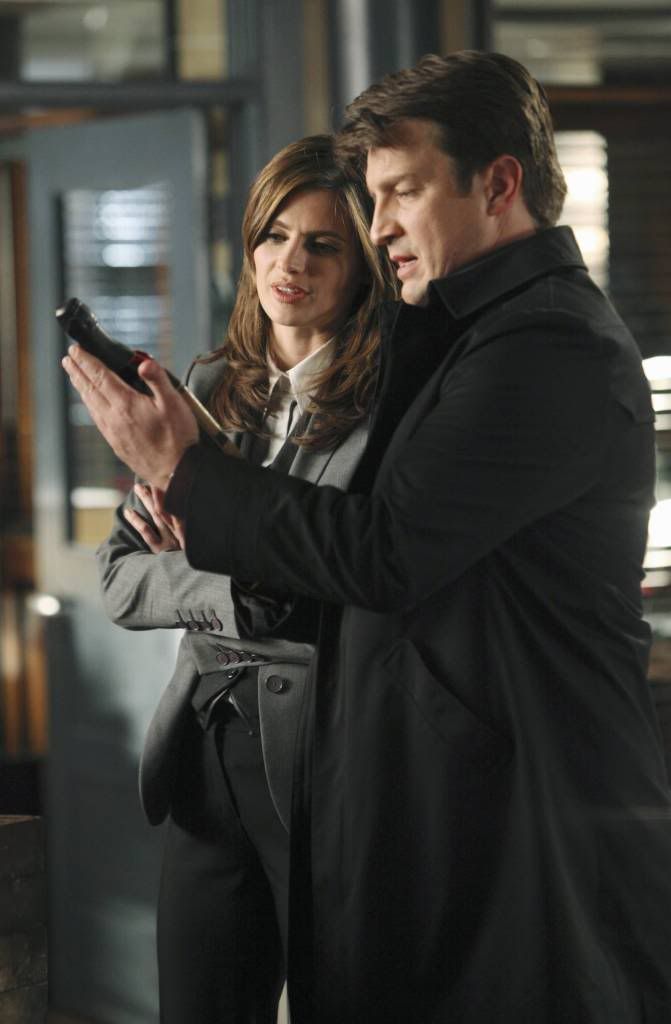
cxgaf.jpg castle and beckett
Beckett and Castle
I'm a huge Nathan Fillion fan, which naturally makes me a huge fan of ABC's Castle. My wife and I sit up Tuesday nights (as soon as I get home from work) and watch new episodes on Hulu Plus. We were particularly excited to see this years season finale (titled 'Always') because of the sneak peak we'd seen.

So we watched the episode and loved it.

And yet... I felt something in the episode didn't work for me. Something that made me feel like the writers botched the character's motivation at the finish line.

** Spoiler Warning ** Spoiler Warning **

Hot and Bothered
I've talked about it with a few people and I think they went where the writers wanted them to go. (To see the conclusion of 'Always', click on the link below and watch it on YouTube -- It's just under three minutes).

As the clip shows, Castle and Beckett finally make their connection and begin kissing heavily. Castle opens her shirt and touches the bullet scar over her heart before holding her hand and walking into his apartment.

My whole problem is that I think the shirt thing is too sexual. Everyone I talked to thought it was as well, but they thought that after four years of being friends, they were just ready to rip each others clothes off.

So after watching it again, I think the writers were going for the connection with how close Castle came to losing Beckett when she was shot in season three's finale. But regardless of whether they were ripping their clothes off, or whether Castle wanted to touch her scar, it came off wrong for me and here's why.
128123_164
Click to watch conclusion of 'Always'

Castle and Beckett's relationship isn't about sex.

In four years, Castle hasn't opened Beckett's clothes in any sexual way. In four years, they've never crossed the line from friendship into something more. Have there been times when they thought about it? Of course! But when you love someone so much that you just want to be in the same room as the object of your affection, sex (while a wonderful part of a healthy relationship) isn't what you really care about. And I believe Castle and Beckett are definitely deeper in their relationship than just wanting to push each other over and bump uglies.

I think Hollywood has a major problem because they feel sex equals intimacy. You would almost wonder if anyone on the West Coast ever fell in love without jumping into bed first. It does happen in the real world, crazy but true.

The writers do try to redeem 'Always' by having Castle and Beckett hold hands and walk into the apartment together, but even that feels like they are heading straight for the bedroom (nudge-nudge, wink-wink). Why not have two or three tentative kisses, the smile, the hand holding, and then Castle leads Beckett into the apartment? Intimate with the smoldering passion we've come to expect.

The Mirror Cracked 
CASTLE
Click to watch Conclusion of The Limey
There is one other episode this season that cheeses me off with what I feel is bad characterization.

 In the episode titled, The Limey, Castle realizes that Beckett has lied to him and begins pursuing other meaningless relationships. My beef with this episode, as the clip shows, is that Beckett, after being rejected by Castle, goes out with the handsome detective from Scotland Yard.

I'm not saying she can't go out with whoever she wants, but how many episodes have we seen where Castle swallows his pride and goes home alone after seeing Beckett heading out with another man? If Castle is man enough to know that if he can't have Beckett and he'd rather be alone, then why should Beckett be written so shallow that she wouldn't go home alone because she's not going with Castle?

It was a total misfire with me and breaks the mirror image that Castle and Beckett were finally getting into the same mindset. This is just one of several episodes where Castle's writers do something that resets the emotional balance between the two characters, ultimately making their connection in 'Always' even more surprising/unbelievable.

Ladies and Gentlemen of the Jury
Anyway... all this nitpicking at these episodes made me remember something David Farland said at his Writers Death Camp. He said people don't like watching movies and T.V. with him because he likes to tear apart the scripts and analyze them. Unfortunately, or fortunately as the case may be, I'm obviously starting to do the same.

So what do you think? After watching the clips, is my interpretation correct or am I just up in the night? Do you tear apart movies and T.V. shows to find what you don't like? Do you find times when you wonder why characters act like they shouldn't?

Saturday, March 24, 2012

Dear Mr. Lucas

One of my only complaints with the re-release of the Star Wars films, and what almost every Star Wars fan has chimed in on, was George Lucas' urge to rewrite Han Solo's shootout with Greedo in the cantina. At the time, he explained that he wanted kids to understand that Han had no choice and had to shoot Jabba's thug.

Well, since then the fans have been in a constant state of  revolt and in a recent Hollywood Reporter article, Mr. Lucas added salt to their wound by saying that Greedo had ALWAYS shot first. That the fans were just confused by camera angles and Han's true motivation.

"The controversy over who shot first, Greedo or Han Solo, in Episode IV, what I did was try to clean up the confusion, but obviously it upset people because they wanted Solo [who seemed to be the one who shot first in the original] to be a cold-blooded killer, but he actually isn’t. It had been done in all close-ups and it was confusing about who did what to whom. I put a little wider shot in there that made it clear that Greedo is the one who shot first, but everyone wanted to think that Han shot first, because they wanted to think that he actually just gunned him down."

Hmmm...

See the problem with revising something that works, to make it more politically correct, is that you screw up your story. And I know this debate has been done to death with Mr. Lucas being the only one arguing in favor of poor Greedo. But, come on, George... don't you think you're stretching it just a bit? It's just a bad revision and I think you're in serious need of a writing group. If I tried to pull that kind of motivation with my crew, I'd be hoisted on my own petard and so should you.

Your problem is that you're so stinking rich, you think you don't need an editor or readers to make a great story (And, honestly, you're not alone). Maybe saying that is a bit over the line, but how in the heck did you think this made any sense? If it wasn't you, I'd be interested to know who told you, "You know... its a terrible thing for Han Solo to shoot someone before that person has a chance to kill him first. What will the children think?"

I'll tell you what the children thought. They thought Han Solo was pretty damn smart to shoot the guy before he got shot. Han tried to talk him out of it, but Greedo was there to collect a bounty, not play sabacc. To think that someone who defends themselves is cold-blooded killer... well... that's dumb.

And for a guy who grew up thinking you were a genius, that's a bitter pill to swallow.

Somebody should have caught you before you tripped into this one. The whole reason for alpha and beta readers, is to prevent you from being disingenuous with your characters. And lets face it, you are fortunate enough to have millions of readers telling you, "No, Mr. Lucas. This doesn't work in your story. If you write it like that, nobody will believe it."

Popular Posts