Showing posts with label David Farland. Show all posts

Friday, July 27, 2012

Save The Cat! - The One Writing Book You Need

https://www.blakesnyder.com/zencart/images/savethecat.jpg
Save The Cat! is by far one of the most talked about writing books. With the subtitle, The Last Book on Screenwriting You'll Ever Need, it certainly has a lot to live up to. But this little gem is by far one of the most valuable books any writer needs to read (and own) and here's why.

Molding Your Idea
Save The Cat! helps develop your idea into a workable (and successful) structure. Too many times we rush off on a writing project without giving the idea time to bloom. But Blake Snyder helps nail down those elusive thoughts into a coherant log line. From there he gives excellent advice on developing your ideas including the populating of your world with the right characters.

Once you've got a good idea for a log line, he gives advice on pitching to anybody and everybody. Not just publishers and producers, but actual people that might be interested in your story. He teaches you how to watch for the broken places in you pitch and how to tweak it.

http://www.blakesnyder.com/wp-content/uploads/2011/04/inception.jpg
Click to see the Inception beat sheet
It's Got a Great Beat
Probably the most important aspect of Save The Cat! is helping you develop your beats. Beats are all the great scenes you've been thinking of as you've fleshed out your story. Blake Snyder explains, using several examples, how to build the perfect story.

If you've ever wanted someone to explain why one film bombed and another was a runaway hit, here is where the magic happens. Blake points out the important parts of story and gives examples from films like Die Hard and Miss Congeniality to show how they got it right. Most importantly, he explains why every step is important.

You may be saying, 'But that just makes the same story over and over.' Au contraire, mon frère. Blake discusses how Hollywood makes stories the 'same but different' and teaches you how to do the same.

Visit Blake Snyder's website and download his free beat sheet outline. Keep in mind, the page count is for screenplays.

Don't Cross That Line
The last sections of the book discusses several rules you should avoid, or at the very least keep in mind, in your writing. Some of his examples were films I thought were awesome, but because of his explanation, I can see why they didn't do better at the all-important box office.

My favorite rule was the Double Mumbo Jumbo. This is a rule that says you should only have one piece of magic per film. When I went to Dave Farland's Death Camp, Dave was the first one to expain this rule to me. I was writing this nice little book about vampires, but I wanted to add werewolves. Dave said, 'nope.' When I asked him why, he said (and I hope I'm phrasing this right) that you can only use one fantastical element per story.

Why?

Because each time you add something extra, it weighs down your story and you lose a little bit of audience. Add another and you lose some more. Keep adding things and pretty soon your readership is an elite clique of friends who 'get' your witty style.

Summary
There are more tools in Blake Snyder's toolbox then I can talk about without printing Save The Cat! word for word. I'm not the first to give it a glowing review and I won't be the last. But believe me, I wish I'd listened to everyone else and got this book two years ago when I first heard about it. It would have saved me a lot of time dithering over my own story structure and trying to figure out what I was missing.

If you don't have it in your personal library, and you're any kind of a writer, get it. You'll be glad you did.

Other writing books I recommend:
Click Links to View
The Successful Novelist - David Morrell
Plot Vs. Character - Jeff Gerke
Characters & Viewpoint - Orson Scott Card
Book in a Month - Victoria Lynn Schmidt
Novelist's Essential Guide to Crafting Scenes - Raymond Obstfeld
Building Believable Characters - Marc McCutcheon

Monday, May 21, 2012

Castle Contentions

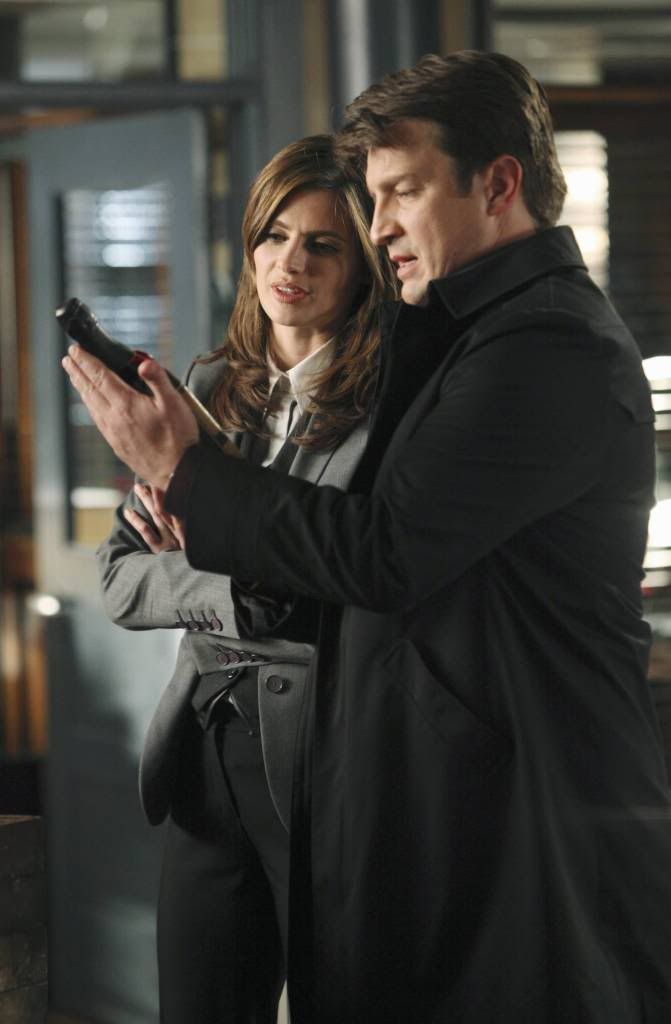
cxgaf.jpg castle and beckett
Beckett and Castle
I'm a huge Nathan Fillion fan, which naturally makes me a huge fan of ABC's Castle. My wife and I sit up Tuesday nights (as soon as I get home from work) and watch new episodes on Hulu Plus. We were particularly excited to see this years season finale (titled 'Always') because of the sneak peak we'd seen.

So we watched the episode and loved it.

And yet... I felt something in the episode didn't work for me. Something that made me feel like the writers botched the character's motivation at the finish line.

** Spoiler Warning ** Spoiler Warning **

Hot and Bothered
I've talked about it with a few people and I think they went where the writers wanted them to go. (To see the conclusion of 'Always', click on the link below and watch it on YouTube -- It's just under three minutes).

As the clip shows, Castle and Beckett finally make their connection and begin kissing heavily. Castle opens her shirt and touches the bullet scar over her heart before holding her hand and walking into his apartment.

My whole problem is that I think the shirt thing is too sexual. Everyone I talked to thought it was as well, but they thought that after four years of being friends, they were just ready to rip each others clothes off.

So after watching it again, I think the writers were going for the connection with how close Castle came to losing Beckett when she was shot in season three's finale. But regardless of whether they were ripping their clothes off, or whether Castle wanted to touch her scar, it came off wrong for me and here's why.
128123_164
Click to watch conclusion of 'Always'

Castle and Beckett's relationship isn't about sex.

In four years, Castle hasn't opened Beckett's clothes in any sexual way. In four years, they've never crossed the line from friendship into something more. Have there been times when they thought about it? Of course! But when you love someone so much that you just want to be in the same room as the object of your affection, sex (while a wonderful part of a healthy relationship) isn't what you really care about. And I believe Castle and Beckett are definitely deeper in their relationship than just wanting to push each other over and bump uglies.

I think Hollywood has a major problem because they feel sex equals intimacy. You would almost wonder if anyone on the West Coast ever fell in love without jumping into bed first. It does happen in the real world, crazy but true.

The writers do try to redeem 'Always' by having Castle and Beckett hold hands and walk into the apartment together, but even that feels like they are heading straight for the bedroom (nudge-nudge, wink-wink). Why not have two or three tentative kisses, the smile, the hand holding, and then Castle leads Beckett into the apartment? Intimate with the smoldering passion we've come to expect.

The Mirror Cracked 
CASTLE
Click to watch Conclusion of The Limey
There is one other episode this season that cheeses me off with what I feel is bad characterization.

 In the episode titled, The Limey, Castle realizes that Beckett has lied to him and begins pursuing other meaningless relationships. My beef with this episode, as the clip shows, is that Beckett, after being rejected by Castle, goes out with the handsome detective from Scotland Yard.

I'm not saying she can't go out with whoever she wants, but how many episodes have we seen where Castle swallows his pride and goes home alone after seeing Beckett heading out with another man? If Castle is man enough to know that if he can't have Beckett and he'd rather be alone, then why should Beckett be written so shallow that she wouldn't go home alone because she's not going with Castle?

It was a total misfire with me and breaks the mirror image that Castle and Beckett were finally getting into the same mindset. This is just one of several episodes where Castle's writers do something that resets the emotional balance between the two characters, ultimately making their connection in 'Always' even more surprising/unbelievable.

Ladies and Gentlemen of the Jury
Anyway... all this nitpicking at these episodes made me remember something David Farland said at his Writers Death Camp. He said people don't like watching movies and T.V. with him because he likes to tear apart the scripts and analyze them. Unfortunately, or fortunately as the case may be, I'm obviously starting to do the same.

So what do you think? After watching the clips, is my interpretation correct or am I just up in the night? Do you tear apart movies and T.V. shows to find what you don't like? Do you find times when you wonder why characters act like they shouldn't?

Friday, September 23, 2011

To NaNoWriMo, or not to NaNoWriMo...

To NaNo, or not to NaNo...

That is the question.

Last year was a big year for me. I decided to really push my writing by signing up to compete in NaNoWriMo (National Novel Writing Month) and going to Dave Farland's Writer's Death Camp. Since the Death Camp started November 6th, I figured that would be the perfect time to start my NaNoWriMo project.

Now, keep in mind that I'd never actually finished a novel before. The one that I came closest to finishing went down in flames when I learned that there was NO chance of selling it. (Lucas Film has this thing that you can't write Star Wars novels unless you're on their approved author list and you can't get on that list unless you've written something they've liked.)

So, I show up at the Death Camp with only an idea of the story I want to write. You know what I forgot?

A lot of plotting and research.

It seems that writers do a LOT of research into the stories they're going to tell. Most of it revolves around character and world building, but I showed up with only the idea of a general plot coupled with a few characters. Fortunately, I managed, with the tolerance of my writing group, to catch up. Seven months later, I'm banging down the last third of the novel I so horrendously began last November.

So, NaNoWriMo is nearing again and I promised myself I wouldn't begin another novel without research. But last night I realized that if I'm going to do NaNoWriMo this year, now is the time to start doing my research. Then again, I also promised myself I wouldn't start a new project until I'm done with the old one.

Either I need an aggressive writing goal or I need sit back and enjoy the journey.

Hmmm...

"To do, or not to do, that is the question:
Whether 'tis nobler in the mind to suffer
The lack of sleep and aching hands,
Or to take caffeine against a crushing word count,
And by opposing end them?"

Tuesday, September 6, 2011

Worldcon Lessons

Friday and Saturday nights, I dreamed I was back at Worldcon. The dreams were very vivid and felt like they took up the whole night. I would wake from one and drift into another. Like the bathroom breaks between the convention panels.

So in my dream, I'm schmoozing a lot of editors when I realize that none of the ones I'm kibitzing with, are ones that are relevant to my writing. For instance, the guy I was chatting with Friday night, was a school book editor and he was asking me where my desire to write textbooks came from. Naturally I made something up. I didn't want to offend the guy since he was being so nice to me. Maybe I'm just afraid my writing is that bad and I'm doomed to write non-stop boredom.


(Remember, none of this really happened.)


Anyway, I realize the real reason for all this insanity is that I was thinking about Worldcon at work on Friday because a good friend wants to hit Worldcon in Chicago next year. But, to be honest, I wasn't that impressed with this one. I felt some of the panels were weak to say the least, even though it was fun watching authors, editors, and agents chat about various topics. And while it was interesting seeing the costumes and quirkiness of fandom, I was there to work.

I assessed everything my writing group and I did during the whole convention and was wondering what we could have done more. This made me remember what Dave Wolverton/Farland said at our Writer's Death Camp. He told us, that when we go to these conventions, we should go sit in the hotel's bar and stay there. When the agents/editors come in to relax a bit, we strike up a conversation and talk about their work and the industry with them. Find out what they like and what they're looking for. Then if the opportunity presents itself, we pitch our book.

The convention itself hosts two types of great networking opportunities: the Kaffeeklatch and the Literary Beer. Both were held in noisy halls, where it was sometimes hard to hear. But at least, with six other people, you got a chance at some face time.

As I thought about the convention on the whole though, I wondered if we should have skipped some of the panels and been offering to take editors out to lunch or dinner. Chat over a soda and such. Or at least looked for extra opportunities to have conversations with them. My writing group doesn't come off as rabid dogs and I think we might have garnered extra time with the editors of our choice. But we're so new to 'cons,' that we didn't think outside the box. Looking at Shaun Ferrall's photos on the Adventures in Sci-Fi Publishing site, that guy was everywhere. His superior ninja networking skills totally put us to shame. And he was only there for one day! He obviously knows how to optimize his time and made great contacts.

There were also three floors of parties going on at the Atlantis, and we only went to the floor with the Tor party. Granted, the Tor party is the one everyone must attend, but what did we miss on the other two floors? Would we have ran into Lee Harris (editor for Angry Robot) and had a nice chat? The world will never know... (Besides, we saw him pressed in the throng at the Tor party, but were too scared to strike up a conversation.)

Maybe Worldcon isn't about the workshop and is actually all about the networking. That's what I think Dave Wolverton was talking about when he mentioned sitting at the bar. Sure there's lots of interesting things to see, but you're there to meet people. To talk with the people in your 'field' and make friendships with them so that you have the connections to get your work looked at.

What it really boils down to, is that with one Worldcon under my belt, I'm not as intimidated by approaching the people I want to talk to. They're genuinely nice people looking for writers with great stories and personalities they can work with.

Will I go to another Worldcon? Maybe. There are a lot of cons around and some are more focused than others. It wouldn't hurt to explore my world. One thing is certain though: there will always be someone there to talk to about the industry and writing.

Popular Posts