Wednesday, September 5, 2012

Questions for the GUTGAA Meet and Greet

Deana Barnhart
Sign Up Now!
The Gearing Up To Get Your Agent blogfest is on! This week, everyone is getting to know each other, so join in on the fun!
-Where do you write?
I just finished a roll-top desk and it's down in my office. My writing space is almost perfect!

-Quick. Go to your writing space, sit down and look to your left. What is the first thing you see?
 My little framed sign that says, 'Butt In Chair'
-Favorite time to write?
Morning to late afternoon. And eleven p.m. to two a.m.  Basically when everyone is asleep or not home.
-Drink of choice while writing?
Cherry Coke
-When writing , do you listen to music or do you need complete silence?
  Instrumental Soundtracks (scores). Especially ones specific to the genre I'm writing.
-What was your inspiration for your latest manuscript and where did you find it?
Donating plasma twice a week. Those people are real vampires.
-What's your most valuable writing tip?
I like quotes, especially when someone says it better than I could. Stephen Cannell said, "I never waited for my Irish Cream coffee to be the right temperature, with a storm happening outside and my fireplace crackling ... I wrote every day, at home, in the office, whether I felt like it or not, I just did it." So my tip: Write. Every. Day.

Halting State Review

Halting State I really liked the concept of Halting State and was excited to read it. That said, I had a really tough time getting through it.

The Good
The story deals with characters tracking down who robbed a bank in the virtual world of an MMORPG (massive-multiplayer online role-playing game), causing the host company to lose $36 million dollars in real world money. Cool concept right?!


The Bad

Unfortunately, Halting State is written in second-person narrative. 

I've always thought writing in second person would be a fun challenge to tackle as a writer, but Halting State showed me the error of my ways.

Some of the time, like when the reader is in the virtual world, second-person is cool. And the comedy performed with it during 'self-reflection' is hilarious. The rest of the time it just plain sucks. I felt like it kept throwing me out of the story.

Audiobook
The audio version of this book was awesome. Robert McKenzie does an amazing job with multiple English/Scottish characters and their accents. Not to mention that his voice is so rich and enjoyable, it should be labeled 'chocolate.'

Final Tally
While the story itself was awesome and well written, I didn't love this book because the 'second-person speed bump' kept whacking me on the head. Read it for the comedy and cool concept, but be sure to take some Tylenol first.

Saturday, September 1, 2012

I Can Quit Whenever I Want... That's What Scares Me

I've missed a whole month of blog writing. I know... bad boy. But it's not exactly like my writing has suffered. Over the last month, I've been knee-deep in rewrites on Blood of Mars. Currently I'm trying to tie all the scenes I wrote into a coherent thread. Making the beginning match the end and all that.

What's Up Chuck... err... Tony?
I was talking to a friend and realized that its been about six months since I stopped playing Star Wars: The Old Republic (SWTOR) so I could focus on my writing.

You have to understand, for me, that's something amazing.

See, first of all, I'm a gamer at heart. Second, I'm a HUGE Star Wars fan. After playing World of Warcraft for almost five years straight, I cut back to just playing a handful of Facebook games. These gave me a little entertainment, but I was worried that when SWTOR was released, I would fall down its magic rabbit hole and I wouldn't write for a long time.

Now, in all honesty, that did happen for about three months. Couple that with moving/unpacking/Christmas and I wasn't doing any noticeable writing for five months. But then I quit doing nothing and gaming to finish my rough draft for Blood of Mars. When that was done, an amazing thing happened.

I didn't go back to gaming.

Why?

Well, mostly it was because I really want to get this bird to an editor so I can start pitching it. But what really happened was that I was having so much fun writing that I didn't need to play a game. Is it stressful? Yes. Is it hard work? Yes. Is it fun? Totally yes!

Keep Moving - Don't Quit!
I still have a lot of regret for those missed five months. Where would my book be now if I hadn't stopped? But when I got back with my writing group, I realized something even worse happened during that time. I started sucking. Sad but true. I'd allowed my writing toolbox to gather dust. When I came back, all my tools were dull.

Have I gotten better? I don't know...

Maybe I never will.

I'm not saying you can't take a day to rest. Everyone needs that. But the longer you quit, the worse you'll get at whatever you enjoy doing.

So, if I went back to gaming now, I'd probably suck. But I'd rather suck at gaming than writing.

What would you rather suck at to achieve your dreams?
Don't Quit
When things go wrong, as they sometimes will,
When the road you're trudging seems all uphill,
When the funds are low and the debts are high,
And you want to smile, but you have to sigh,
When care is pressing you down a bit,
Rest, if you must, but don't you quit.

Life is queer with its twists and turns,
As every one of us sometimes learns,
And many a failure turns about,
When he might have won had he stuck it out;
Don't give up though the pace seems slow
You may succeed with another blow.

Often the goal is nearer than,
It seems to a faint and faltering man,
Often the struggler has given up,
When he might have captured the victor's cup,
And he learned too late when the night slipped down,
How close he was to the golden crown.

Success is failure turned inside out
The silver tint of the clouds of doubt,
And you never can tell how close you are,
It may be near when it seems so far,
So stick to the fight when you're hardest hit
It's when things seem worst that you must not quit.

- Author unknown

Friday, July 27, 2012

Save The Cat! - The One Writing Book You Need

https://www.blakesnyder.com/zencart/images/savethecat.jpg
Save The Cat! is by far one of the most talked about writing books. With the subtitle, The Last Book on Screenwriting You'll Ever Need, it certainly has a lot to live up to. But this little gem is by far one of the most valuable books any writer needs to read (and own) and here's why.

Molding Your Idea
Save The Cat! helps develop your idea into a workable (and successful) structure. Too many times we rush off on a writing project without giving the idea time to bloom. But Blake Snyder helps nail down those elusive thoughts into a coherant log line. From there he gives excellent advice on developing your ideas including the populating of your world with the right characters.

Once you've got a good idea for a log line, he gives advice on pitching to anybody and everybody. Not just publishers and producers, but actual people that might be interested in your story. He teaches you how to watch for the broken places in you pitch and how to tweak it.

http://www.blakesnyder.com/wp-content/uploads/2011/04/inception.jpg
Click to see the Inception beat sheet
It's Got a Great Beat
Probably the most important aspect of Save The Cat! is helping you develop your beats. Beats are all the great scenes you've been thinking of as you've fleshed out your story. Blake Snyder explains, using several examples, how to build the perfect story.

If you've ever wanted someone to explain why one film bombed and another was a runaway hit, here is where the magic happens. Blake points out the important parts of story and gives examples from films like Die Hard and Miss Congeniality to show how they got it right. Most importantly, he explains why every step is important.

You may be saying, 'But that just makes the same story over and over.' Au contraire, mon frère. Blake discusses how Hollywood makes stories the 'same but different' and teaches you how to do the same.

Visit Blake Snyder's website and download his free beat sheet outline. Keep in mind, the page count is for screenplays.

Don't Cross That Line
The last sections of the book discusses several rules you should avoid, or at the very least keep in mind, in your writing. Some of his examples were films I thought were awesome, but because of his explanation, I can see why they didn't do better at the all-important box office.

My favorite rule was the Double Mumbo Jumbo. This is a rule that says you should only have one piece of magic per film. When I went to Dave Farland's Death Camp, Dave was the first one to expain this rule to me. I was writing this nice little book about vampires, but I wanted to add werewolves. Dave said, 'nope.' When I asked him why, he said (and I hope I'm phrasing this right) that you can only use one fantastical element per story.

Why?

Because each time you add something extra, it weighs down your story and you lose a little bit of audience. Add another and you lose some more. Keep adding things and pretty soon your readership is an elite clique of friends who 'get' your witty style.

Summary
There are more tools in Blake Snyder's toolbox then I can talk about without printing Save The Cat! word for word. I'm not the first to give it a glowing review and I won't be the last. But believe me, I wish I'd listened to everyone else and got this book two years ago when I first heard about it. It would have saved me a lot of time dithering over my own story structure and trying to figure out what I was missing.

If you don't have it in your personal library, and you're any kind of a writer, get it. You'll be glad you did.

Other writing books I recommend:
Click Links to View
The Successful Novelist - David Morrell
Plot Vs. Character - Jeff Gerke
Characters & Viewpoint - Orson Scott Card
Book in a Month - Victoria Lynn Schmidt
Novelist's Essential Guide to Crafting Scenes - Raymond Obstfeld
Building Believable Characters - Marc McCutcheon

Friday, July 20, 2012

Why Grover Is A Successful Character

Super Grover
In 1967, the Muppet known as Grover (going under various names until 1970) was created. Since that time, he continued to be a strong character in a cast of many. But the creative minds at Children's Television Workshop brought another Muppet to Sesame Street who is very Grover-ish, hoping to revive the show.

Elmo may have breathed new life into the flagging children's program, but the cool monsters were already there (these monsters were, of course, cute and fuzzy). I understand why Elmo was picked. He's red (i.e. flashy) and talks and thinks like a child. I think this was done to catch a wider audience, but let me explain why I think Grover is still a better character.

He Was An Adult Learning With Kids
Don't Look Grover! Hairy Monster Behind You!
Grover was a 'grown-up' monster. If you don't think he was an 'adult' monster, then you have to at least concede that Grover was older than all the kids on the show. But his age never stopped him from learning new things and sometimes being embarrassed when he didn't know something. Sometimes he was even afraid of things and the kids had to help and teach him.

Imagine that. An adult learning from kids.

Just think what that does to a child's morale when they understand something that an older person doesn't. I believe this was his biggest teaching technique.


He Always Tried New Things
Grover was very curious and from a child's perspective, almost everything they experience is new and sometimes confusing. But when someone older can say, "Wow! I didn't know that," it shows kids that they're not alone. It gives them an ally they can stand with when things get confusing or frightening. Since Grover didn't know a lot of things himself, he had a full world to explore.

As a writer, I've learned that this is a successful tool many published authors use to give exposition. A character who doesn't know something, gives the opportunity to teach.


The Monster at the End of This Book
A Must Read!
He Always Tried Hard
Nothing stopped Grover from doing something. Well... sometimes. Crazy fits ensued if he got too frightened or impatient. But he always tried.

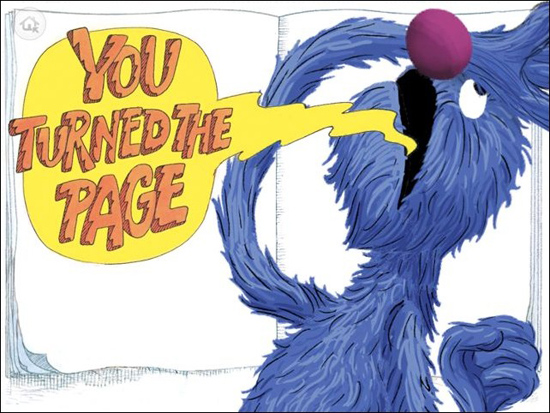
My all-time favorite children's book is, The Monster at the end of this Book. If you have children, I can't recommend this one enough to you. One word of warning though, this is a book you HAVE to read to your kids and it will cause endless requests for re-reads.

The premise of the book is in the title. Grover is a participant with the reader in the book (just as he is on Sesame Street) and suddenly realizes he doesn't want to see the monster at the end of the book.
Grover Sesame Street Monster at the End of this Book iPad iPhone App
Stop Turning Pages!

Monsters are scary after all...

But the reader keeps turning pages (even better when you let the kids turn the pages)! So Grover is forced to come up with elaborate ways to prevent pages being turned. With fun illustrations, this book gives the reader an opportunity to let out their inner ham as they portray the rapidly panicking Grover. And if you can read the book in Grover's voice, it's even better.

There is also an interactive app that reads the book to kids (available for the same price as the book - $3.99). [Click here to see a video of it on YouTube]

Last Bit
So when you're watching a show, consider the characters and who their target audience is. Think about why they work or don't work. And if you're writing a book, think about your target audience and how you can best make your characters into the reader's close friends.

Monday, July 9, 2012

Why Redemption Stories Work

I'm a big fan of redemption stories. From books to film, there's nothing better than seeing a terrible person become someone I like. But why do stories like these have such a strong attraction? Here's three examples that highlight why I think they're so popular.


The Characters Overcome Themselves
http://images4.wikia.nocookie.net/__cb20070103001537/starwars/images/thumb/0/0b/Purge.jpg/220px-Purge.jpg
Vader Attacks Jedi on Kessel
It may be a little bit schadenfreude (pleasure from other's pain), but we like watching others overcome adversity.

One of my all time favorite redemption stories is Star Wars. Sure the whole saga has rebels and Imperials battling for supremacy, but the only character who has to make the decision between right and wrong is Anakin Skywalker. Even if George Lucas decided unconsciously, he chose well when he set the framework for Star Wars on the redemption story of Darth Vader. With the entire galaxy mirroring the choices of one man, the stakes are dangerously high.

But the choice has already been made, right? Darth Vader is a bad guy.

Yes, but what fun is that? If you like tragedies, then maybe you're okay leaving it there. But most people, myself included, prefer to hope for something better. We want the bad guy to either get beaten (the hero wins) or have the villain see the error of his ways and stop the insanity he's set in motion. And how amazing is a story when both happen?

Vader, behind the mask, actually feels sorry for what he's done. The price he paid to become the Dark Lord was higher than he expected and reversing that choice will literally tear an empire apart and destroy him. But he'll make that choice because he has to.

They Show That Those Who Fall Are Just Like Us
https://encrypted-tbn3.google.com/images?q=tbn:ANd9GcQ7KZ5vPsT-3_JOUM7NHWJnC6zjblxZE99aOauwZVnzkJYhWxnFeg
Macbeth's Regret
In his book, Story, using the tale of Macbeth, Robert McKee shows what actually makes characters more likeable. In Act 2, Scene 2, Macbeth has given into his wife's urging and killed the king in order to promote himself. But instead of being happy over his life to come, he can only think about what he's done. 
I'll go no more:
I am afraid to think what I have done;
Look on it again I dare not.

... 
Will all great Neptune's ocean wash this blood
Clean from my hand? No, this my hand will rather
The multitudinous seas in incarnadine,
Making the green one red.

Macbeth feels remorse and guilt for what he's done. Have you ever felt remorse or guilt? Of course you have! When we fail, we have to pick ourselves back up and try again. Of course, I'm not saying our sins are at Macbeth's level, but we like to see someone fall and get back up again because we've fallen and had to get back up again too. 

They Provide Hope
https://encrypted-tbn0.google.com/images?q=tbn:ANd9GcS2UZgiFz2T8HVnLhPlNTGhiWBeY6Pb6CZt56-LQ0IKWA3cN4fiiA
Max Bringing Charlie Back From the Edge
One of my current favorite redemption movies is Real Steel (oddly enough, it's another story where the son brings his father back from the edge). Even from the beginning, we like down-and-out loser, Charlie. He's a hard working ex-boxer, who is witty and funny. But he also rushes in to things far too quickly. He's arrogant, self-centered, and has lost everything in the world of robot boxing.

Enter Max, the likeable kid who's thrown into Charlie's world and see's his dad for what he is, a hustler and consummate bull-crap artist. But Max has all of Charlie's good habits, without the cynicism that comes from his father's experience.

Instantly, we hope Charlie can pull himself together for Max's sake. That hope keeps you going through one try/fail cycle after another. But when it finally does pay off, the rush from the emotional payoff is pure gold. And that is why redemption stories will always be popular. Because the elation we feel from seeing someone overcome themselves and arrive at a better place.

The Final Frame
So what are some of your favorite redemption stories and why? Are there aspects of redemption stories that you hate?

Popular Posts